Mini Playbook · Hiring & Mobility · Autonomy Tier: 1
Not all pipelines are created equal — but most teams treat them as if they are.
Inbound, outbound, and referrals don’t behave the same — and your strategy, time allocation, and automations should reflect that. This is a quick snapshot you can use to explain why “just post the job everywhere” is not a hiring strategy.
1. Source Quality Snapshot
A simplified view of how many candidates each channel needs to produce a hire (illustrative numbers, directionally accurate for tech & GTM roles).
Example: For this role family, ~250 inbound applicants, ~40 sourced candidates, or ~20 referrals are needed to produce one hire.
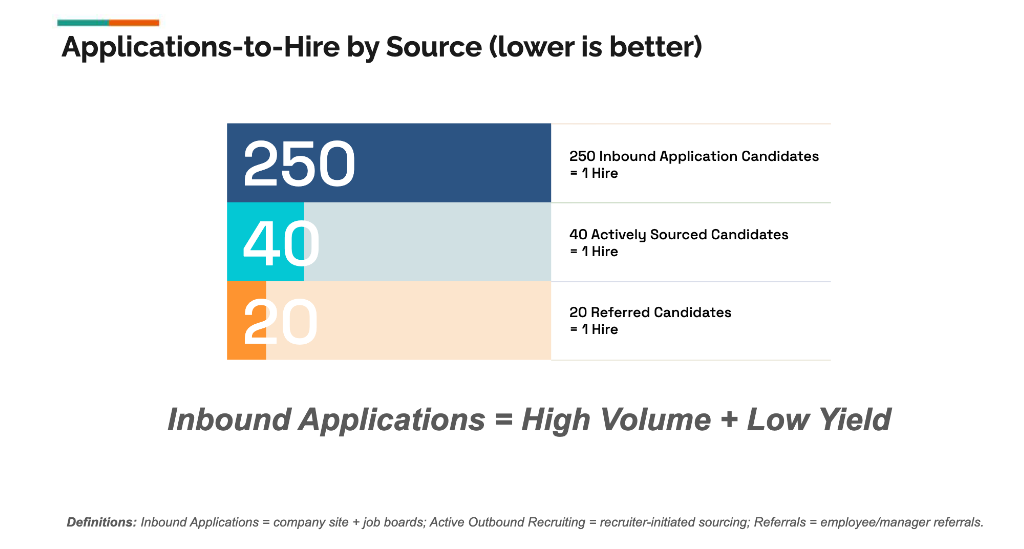
| Source | Candidates per Hire | Signal |
|---|---|---|
| Inbound | ≈ 250 | Very high volume; low average signal. |
| Outbound / Sourced | ≈ 40 | Curated profiles, stronger alignment. |
| Referrals | ≈ 20 | Highest intent and cultural fit. |
2. What the Data Tells Us
Inbound is noisy
- 250 resumes per hire is expensive in recruiter hours.
- Most inbound funnels hide extreme variance in quality.
- Low-signal noise = inconsistent decisions + fatigue.
Outbound has stronger alignment
- Higher ICP match.
- Higher likelihood of reaching final stages.
- Far less variability than inbound noise.
Referrals are the efficiency engine
- Employees pre-filter for fit.
- Hiring managers trust referrals more.
- Shorter time-to-hire due to built-in credibility.
3. Strategic Implications
Rebalance recruiter time
- Reduce time spent manually triaging inbound.
- Automate inbound triage where safe (Tier-1).
- Shift recruiter hours toward targeted outbound.
Spend where it matters
- Cut low-performing job boards.
- Invest in referrals; they convert.
- Upgrade sourcing tools for targeted outreach.
If we want velocity and quality, we must invest in the sources that convert — not the sources that simply generate the most résumés.
4. Metrics Integration
- Candidates per hire by source
- Pass-through by stage (screen → interview → offer)
- Time-to-hire by source
- Recruiter hours per hire by source
Use this quarterly to rebalance budget, recruiter specialization, and channel strategy.
5. Recommended Actions
- Establish baselines. Run a 6–12 month lookback by role family.
- Set targets. Example: “40% of hires from referrals + outbound.”
- Automate inbound triage. Reduce manual review load.
- Invest in high-signal channels. Referral enablement + outbound tooling.
- Review quarterly. Watch source mix + conversion improve.
Let's Connect
Open to roles in People Analytics, Talent Intelligence, People Ops, and Recruiting Operations — especially teams building internal AI capabilities.