Pipeline Health A[i]gent
Real-time insights that eliminate bottlenecks and improve time-to-hire.
Hiring & Mobility
Explore the Tool →
Recruiting Operations · Governed Automation · MBA, Data Analytics · SF Bay Area · Credentials & Recommendations
Recruiter turned systems builder. Thousands of interviews across every stage gave me the ground-level insight into where talent systems break on the daily: the pain points for candidates, the friction for hiring managers, the heavy lift for recruiters, and a million micro signals in between.
I bring the practitioner knowledge most build teams don't have and the technical range to act on it. I am the bridge between algorithm and human rhythm.
AI can fake a resume. It can't fake who you are.
Find what's real. Measure what matters. Decide with evidence.
In the age of AI-assisted applications, the resume is no longer a reliable signal. What candidates write has been optimized, coached, and in many cases generated. What they do is harder to fake.
Agent-verified facts not resume keywords. The Screening A[i]gent tool reviews applications against what's actually observable and measurable. Prior employer research: tech stack, role function, industry. Experience, authored content, speaking events, recommendations, uncovered across multiple sources.
Observable behavior, not self-reported claims. I/O psychology-proven behavioral signals that predict performance: engagement patterns, response quality, and consistency across touchpoints that can't be fabricated at scale.
Explore the Tool →Pipeline velocity, funnel conversion, recruiter capacity, time-to-fill. The data every hiring team needs and almost none can see in real time.
The Pipeline Health A[i]gent tool surfaces funnel diagnostics across active requisitions. Benchmarks, conversion rates, and bottleneck flags — live from your ATS. Before anyone has to ask.
Explore the Tool →Attention to detail is observable. Conscientiousness is observable. Motivation is observable. We just never tracked it.
Score what candidates do. Not what they say. 30 behavioral signals across four I/O psychology-grounded constructs science shows predict job performance, tracked from the moment they apply to the moment you decide, and beyond.
Grounded in evidence, not instinct. Auditable by design.
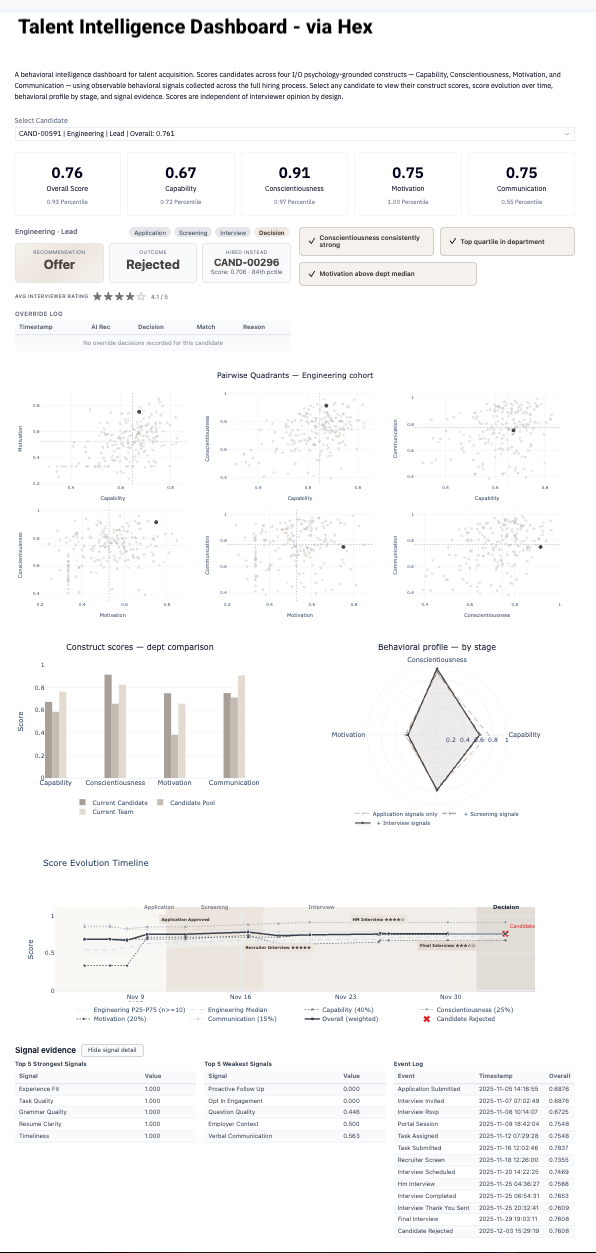
The same concepts used to evaluate AI/LLM reliability: consistency, calibration, and variance across outputs apply directly to human hiring decisions.
Few organizations have ever measured whether their hiring decisions hold up to scrutiny.
This one does. Every recommendation, every decision, every outcome is connected, tracked, and visible so the process improves over time.
The system tracks when recommendations are overridden, if we are choosing the highest scores, tells us whether what we hired for actually predicted performance, if our decisions are drifting from standards.
It surfaces the patterns that quietly shape hiring decisions, including how interviewers score.
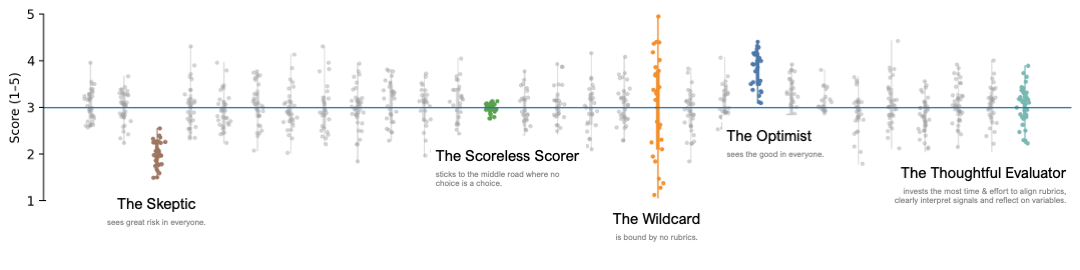
Bringing Decision Science to hiring
Real-time insights that eliminate bottlenecks and improve time-to-hire.
Frameworks for higher-quality, lower-bias application evaluations.
Headcount goals into operational reality.
Candidate behavioral scoring & insights.
Stage changes, dispositions, structured fields, and clean updates where the work actually lives.
Transcript capture, highlights, and searchable summaries to reduce loss and improve continuity.
Routing, availability capture, and coordination so throughput isn't limited by calendar friction.
Consistent evaluation inputs so decisions can be compared, audited, and improved over time.
Comp inputs, approvals, and handoffs that move fast while staying accountable.
EEO/OFCCP hygiene, audit trails, and reporting surfaces that teams can trust.
Tools are the interface. The system is the operating model.
Shared signals, decision logic, guardrails, and escalation paths run across every tool so decisions remain consistent.
Uncovering the hidden variability in hiring decisions.
And what the successful 5% do differently.
Solving Bias, False Negatives & Lost Revenue in High Volume Recruiting.
Preventing bottlenecks and saving 8+ recruiter hours per week.
How throughput modeling aligned KPIs with capacity.
Open to roles in People Analytics, Talent Intelligence, People Ops, and Recruiting Operations — especially teams building internal AI capabilities.