Hiring Operations Intelligence
Most hiring analytics measure one thing: volume. This system measures three — the process, the people, and the decisions — so every layer of the hiring operation becomes observable, comparable, and improvable.
Workflow Intelligence — Process Analytics
Detects pipeline risk before hiring goals are missed.
The operational layer. Measures how work actually moves — where it accelerates, where it stalls, and what structural patterns predict outcomes before they happen.
Every stage transition, scheduling delay, and pass-through rate leaves a measurable trace. Process analytics turns that trace into a real-time picture of pipeline health that teams can act on — not just report on.
The tools in this layer prevent the chaos of running full force into the unknown. The Funnel Calculator, for example, converts a hire target into the weekly stage volume required to hit it — applications, screens, HM interviews, finals, offers, making assumptions explicit and flagging where the plan breaks before the quarter does. Working alongside the Pipeline Health A[i]gent, it surfaces when actuals are drifting from plan so teams can adjust before goals become out of reach.
Talent Intelligence — Performance Analytics
Identifies candidate quality beyond resumes using observable behavior.
The people layer. Measures what candidate behavior during the hiring process reveals across four dimensions — before a single interview score is submitted.
I/O psychology research shows that how people engage with a process is itself a signal. Responsiveness, follow-through, communication quality, and attention to detail during hiring predict the same patterns on the job.
Capability
- Task quality
- Knowledge depth
- Experience fit
- Held a similar role
- Tech exposure
- Tech depth
- Past Employers
- Recommendations
Communication
- Clarity in communications
- Verbal skills
- Question quality
- Sentiment
- Grammar
- Syntax
- Typos
- Formatting
Conscientiousness
- Responsiveness
- Follow-through
- Reliability
- Meets deadlines
- No shows
- Preparedness
- Follow up
- Closes the loop
Motivation
- Self selection
- Responsiveness
- Proactive
- Engagement
- Scheduling Urgency
- Initiative
- Digital resource use
Decision Intelligence — System Analytics
Measures whether hiring decisions are consistent, calibrated, and predictive.
The judgment layer. Measures how reliably internal hiring decisions are made — and where inconsistency, bias, or variance is degrading quality without anyone noticing.
Hiring decisions are made by humans under pressure, with incomplete information, and without a feedback loop. Decision science applies structured measurement to that judgment layer — making variance visible, patterns diagnosable, and improvement possible.
Interviewer Calibration
- Scoring variance by interviewer
- Rubric adherence rates
- Score distribution patterns
- Halo and recency effect indicators
Decision Consistency
- Panel agreement rates
- Override frequency and direction
- Debrief-to-decision alignment
- Decision speed vs. accuracy
Outcome Feedback
- Hire quality correlation
- Early attrition by group
- Offer decline patterns
- Closed-loop signal refinement
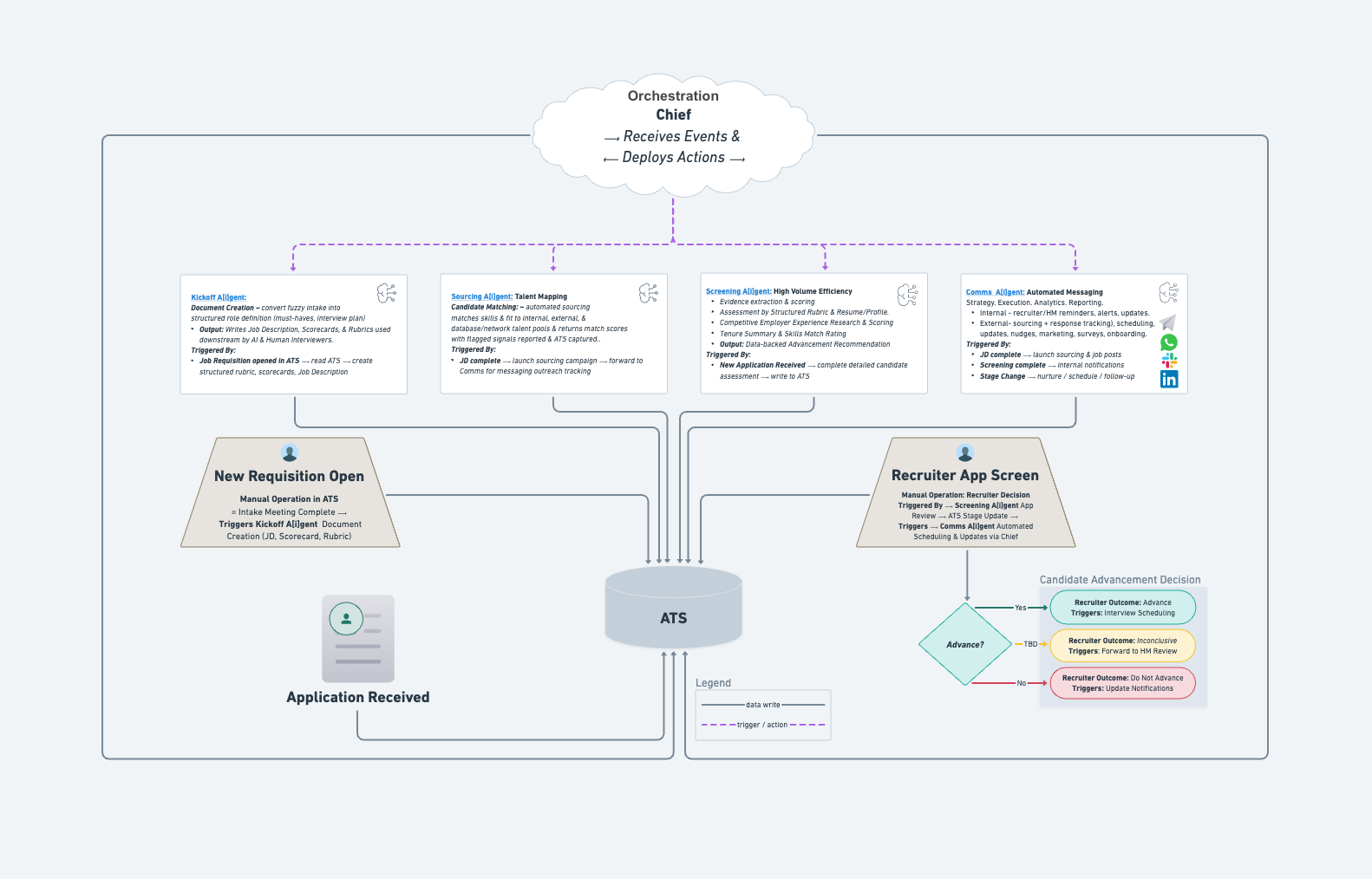
Operational Flow — Example
How the three measurement layers connect across a hiring workflow.
Governance
Autonomy is not assumed. Safe automation depends on clear decision rights, stable definitions, and explicit thresholds so systems remain accountable and consistent across tools.
Let's Connect
Open to roles in People Analytics, Talent Intelligence, People Ops, and Recruiting Operations — especially teams building internal AI capabilities.